Community trade value
A moving estimate of what players exchange for an item. It depends on supply, demand, build popularity, update expectations, and how easily the item can be replaced.
VV Ultimatum trade values are community prices, not permanent NPC numbers. A Hogyoku, essence, bell, charm, weapon, or rare material can move quickly after an update, duplication scare, farming change, or build trend. This guide shows where to check a current value list, how to compare two offers, and how to avoid turning a useful item into a bad trade.
Use a recently dated community list as a starting point, then confirm demand in the current server before accepting.

Start with the current community value-list server or a recently published value-list update. Check the date, identify the exact item and variant, compare more than one recent offer, and separate player-trade value from NPC sell price. Never treat one video, one screenshot, or one trader's claim as a permanent conversion rate.
There is no official Roblox price board that guarantees a permanent player-to-player exchange rate. The most useful public signal is the community-run VV: Ultimatum value-list server, supported by recent value-list videos and active trade discussions. Treat those sources as market observations rather than developer promises.
A current list is valuable because it compresses many trade observations into a readable baseline. It is still only a baseline. Low-volume items can look stable until one popular build, event, or farming method changes supply. Before a large trade, search the exact item name in recent discussions and compare what owners are asking with what buyers are actually willing to give.
This page intentionally does not publish a frozen numeric table copied from a July screenshot. That would look useful for a few days and then become misleading. The better workflow is to link the live source, explain how to read it, and keep fixed NPC or progression facts separate from the floating community market.
| Source | Best use | What to verify |
|---|---|---|
| Community value-list server | Fast baseline for relative tiers and recent list updates | Check the list date, item notes, and whether the ranking is demand-based or value-based. |
| Recent value-list video | See list changes, examples, and the creator's reasoning | Use the publish date; a video is a snapshot, not a permanent price guarantee. |
| Official game and Discord | Confirm updates, item changes, events, and whether a source is legitimate | Official channels may explain mechanics but usually do not set player-market prices. |
| Recent trade offers | Test whether the listed value can actually be exchanged in today's market | Asking prices are not completed trades; compare several offers and avoid pressure tactics. |
Many confusing VV Ultimatum values come from mixing different systems. Label the number or claim before using it in a trade.
A moving estimate of what players exchange for an item. It depends on supply, demand, build popularity, update expectations, and how easily the item can be replaced.
How easy it is to find a buyer or complete an upgrade. Two items can have similar listed value while the high-demand item is much easier to trade.
A game-defined coin amount or shop cost. This can help measure a floor or replacement cost, but it does not automatically equal player-market value.
The practical value of keeping an item for your own build, quest, reroll, crafting step, or unlock. An apparently profitable trade can still slow your account.
Do not compare item names alone. Compare acquisition time, current utility, demand, quantity, restrictions, and the risk that an update changes either supply or usefulness. Consumables often trade differently from permanent gear because every use removes supply, while farmable materials can fall when a faster route becomes popular.
Hogyoku and progression essences deserve extra caution because their own-account utility may exceed an attractive-looking offer. Bells, charms, weapons, and modified gear need exact variant checks. A common base item and a desirable modified version should not be treated as the same listing.
| Item group | Main value drivers | Check before trading |
|---|---|---|
| Hogyoku and major progression items | Rarity, unlock utility, update demand, replacement time | Confirm whether you still need it for your faction or build before comparing offers. |
| Essences and consumables | Drop route, consumption rate, reroll or skill demand | Verify the exact essence type and whether the current patch increased supply. |
| Bells, charms, accessories | Build fit, rarity, modifier, PvE or PvP demand | Match the exact name and variant; inspect modifier details before confirming. |
| Weapons and modified gear | Base rarity, moveset demand, modifier quality, upgrade state | Do not price a modified or upgraded item as if it were the plain base version. |
| Farmable materials | Route speed, event availability, crafting demand | Compare the time needed to replace the quantity, not only the value of one unit. |
| Limited or event items | Remaining supply, collector demand, return risk | Ask whether the item can return; scarcity claims are easy to exaggerate. |
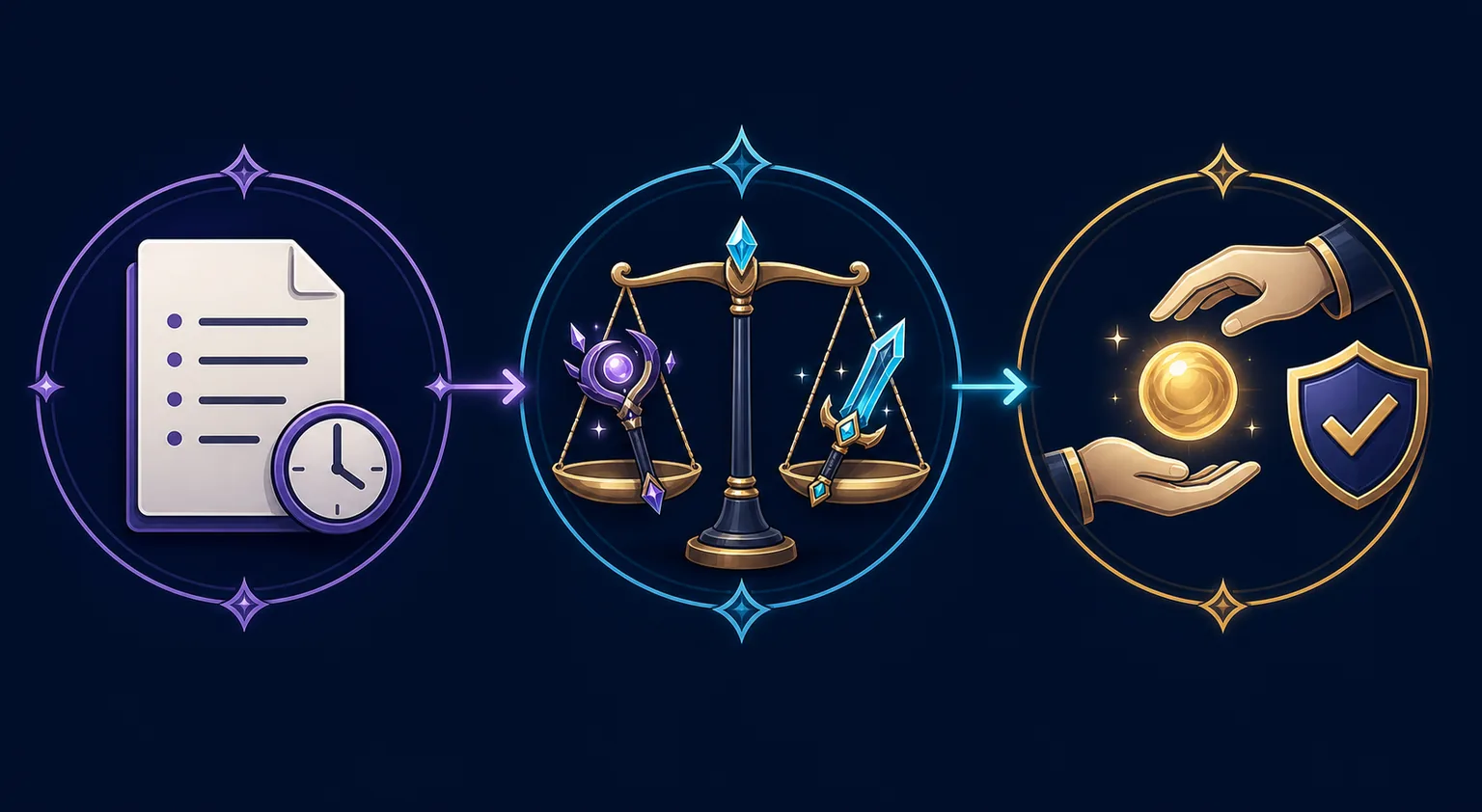
The safest comparison is a short repeatable process. It prevents a flashy overpay claim from replacing basic verification.
For a large trade, pause after the offer is assembled and read every slot again. Quantity changes, similar item icons, and last-second substitutions can turn a fair discussion into a different deal.
The embedded community video was published recently and is directly focused on the VV Ultimatum value list. Use it to understand the current list structure and changes, then verify the list date and live offers before making a major trade. The video is community material, not an official developer price table.
A fair value comparison is only useful if the exchange itself is safe. Keep the transaction inside supported game systems and make every final check visible.
Re-read the final window after any change. Similar icons, quantities, or names can hide a substitution.
A claim that the offer expires in seconds is not market evidence. Pause and compare before accepting.
Do not hand items to a stranger because a display name, role color, or copied profile claims to be trusted.
Avoid real-money, gift-card, account, script, or external payment deals. They add fraud and account-risk problems beyond item value.
A cropped list with no date or source can be old or edited. Open the current source instead of trusting the image.
An offer can be market-fair but account-bad if the traded item blocks your next unlock or takes many hours to replace.
Use the current community value-list server as a baseline and compare it with recently dated value-list updates and live trade offers. No community list should be treated as an official permanent price guarantee.
No. Player trade values are community market estimates. Developers control item mechanics, supply, shops, and updates, but the player market decides what offers are accepted.
Supply, demand, build popularity, farming routes, events, balance changes, duplication concerns, and expectations about future updates can all move an item.
Demand can be just as important. A slightly lower listed item with strong demand may be easier to trade than a theoretically valuable item with few buyers.
Match exact items and quantities, check a dated value source, compare current offers, consider replacement time and personal progression, then inspect the final trade window before confirming.
Only after checking whether your own faction, build, reroll, or progression path still needs them. Their account utility may be greater than a tempting market offer.
Not by itself. NPC price is a fixed game value, while player trade value reflects rarity, utility, demand, and replacement time.